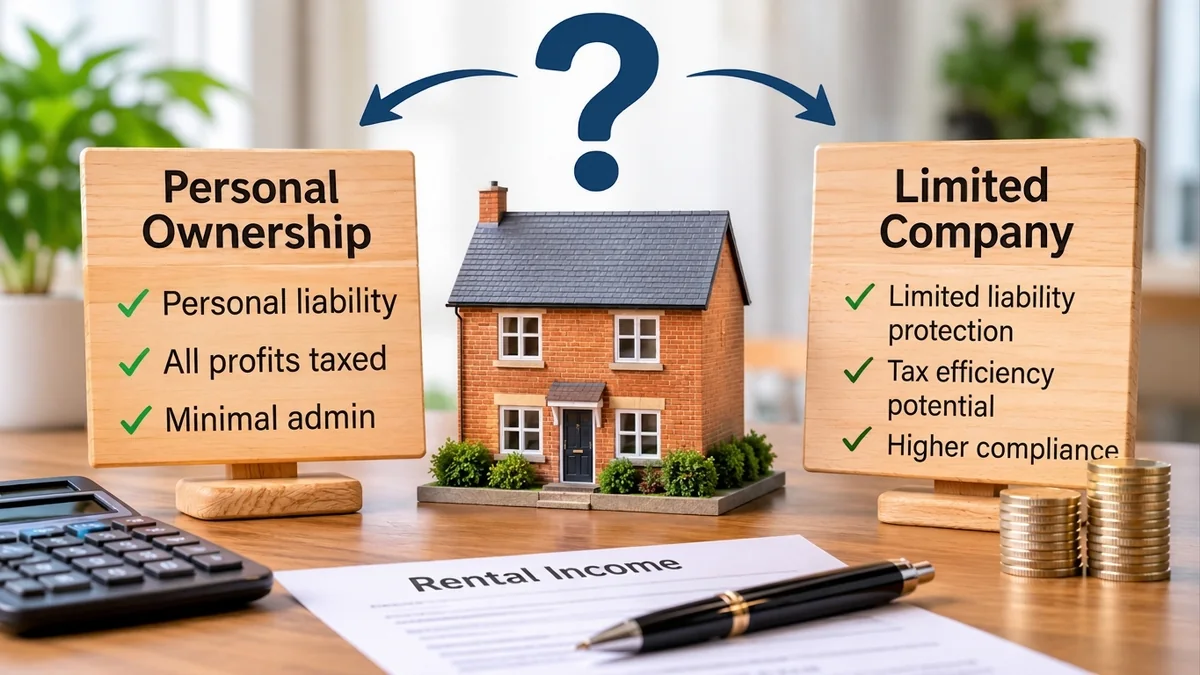
Starting a business means deciding how to run it: as a sole trader or through a limited company. Both options have pros and cons. The right choice depends on your profits, how you want to take money out, your plans for growth and how much financial protection you need.
1. What is the difference?
A sole trader owns and runs a business personally. There is no legal separation between you and the business.
A limited company is a separate legal entity, owned by shareholders and managed by directors. Even if you are the only director and shareholder, the company remains legally separate from you.
| Sole trader | Limited company |
|---|---|
| Simple to set up and run | Must be registered with Companies House |
| You and the business are legally the same | Separate legal identity |
| You are personally responsible for business debts | Liability is generally limited |
| Pays Income Tax and National Insurance on profits | Pays Corporation Tax on company profits |
| Less administration and reporting | Annual accounts and company tax returns required |
| Business profits belong to you | Company money belongs to the company |
Both can employ staff and register for VAT where required.
2. How are they taxed?
Tax is one of the biggest differences between the two.
Sole trader
You pay Income Tax and Class 4 National Insurance on your business profits, whether you take the money out or leave it in the business.
For 2026/27, Income Tax rates are 20%, 40% and 45%, after the Personal Allowance of £12,570. Class 4 National Insurance is 6% on profits between £12,570 and £50,270, and 2% above that. (Scottish Income Tax bands differ.) See current Income Tax rates and self-employed National Insurance rates.
Limited company
A limited company pays Corporation Tax on its profits. For 2026/27, the rates are:
- 19% on profits up to £50,000
- 25% on profits above £250,000
- Marginal relief applies in between
Directors can take money out as salary and dividends. Salary generally reduces the company’s profits for Corporation Tax. Dividends are paid from profits after Corporation Tax. They are taxed personally, but do not attract National Insurance. Dividend tax rates rose in April 2026 to 10.75% for basic-rate and 35.75% for higher-rate taxpayers, after a £500 tax-free allowance. See Corporation Tax rates and tax on dividends.
3. Which structure is more tax-efficient?
There is no fixed profit level at which a limited company automatically becomes the better option. Many people assume it pays off once profits reach £40,000 or £50,000, but under current rates that is not necessarily true.
Here is an illustrative comparison for 2026/27:
| Annual profit | Sole trader take-home | Limited company take-home |
|---|---|---|
| £30,000 | £25,468 | £24,403 |
| £50,000 | £40,268 | £38,862 |
| £60,000 | £46,111 | £46,091 |
| £70,000 | £51,911 | £51,042 |
| £80,000 | £57,711 | £55,765 |
The limited company figures assume a £12,570 director salary (with employer National Insurance), all remaining profit paid out as dividends, no Employment Allowance, no other income, and 2026/27 rates outside Scotland. They exclude accountancy fees and other running costs, which are usually higher for a limited company.
As the figures show, a limited company does not automatically save tax, even at higher profits.
When can a limited company be more tax-efficient?
It may offer more tax-planning opportunities if:
- You can leave some profit in the company rather than taking it all out.
- You want to make employer pension contributions through the company, which reduce Corporation Tax.
- There are other genuine shareholders who can receive dividends.
- You want more control over when you receive personal income.
Leaving profit in the company can defer personal tax, but it does not remove it.
4. What extra costs come with a limited company?
A limited company has more administration and higher fixed costs:
- Accountancy fees: Expect to pay more. A company needs statutory annual accounts, payroll if you take a salary, and a Corporation Tax return (CT600), as well as your personal tax return.
- Filing fees: Companies House charges £100 to incorporate online and £50 a year for the confirmation statement. See Companies House fees.
5. Does having employees make a difference?
Both sole traders and limited companies may be able to claim Employment Allowance of up to £10,500 a year (2026/27). It reduces your employer National Insurance bill, and it only helps if you actually owe employer NI, which starts at £5,000 per employee.
There is one restriction for companies. If the director is the only person paid above £5,000 a year, the company cannot claim. Once another employee or director is paid above that level, the company may qualify.
A sole trader who employs one person paid above £5,000 may qualify. So the number of employees and their pay can change your overall costs. See Employment Allowance eligibility and 2026/27 employer National Insurance thresholds.
6. Making Tax Digital: what do sole traders need to know?
Making Tax Digital (MTD) for Income Tax started in April 2026 for sole traders whose qualifying income was over £50,000 for 2024/25. The threshold falls to £30,000 for 2025/26 (from April 2027) and £20,000 for 2026/27 (from April 2028). Qualifying income includes gross income from self-employment and property, and the start date is based on the relevant earlier Self Assessment tax return.
If you are in scope, you must keep digital records, send quarterly updates to HMRC and file a final declaration at the end of the year instead of a Self Assessment return. MTD for Income Tax does not apply to limited company profits. Check the current Making Tax Digital for Income Tax requirements.
7. So, which structure should you choose?
There is no one-size-fits-all answer. The right choice depends on your expected profits, personal circumstances and plans for the business.
- Choose sole trader if you run a small business or freelance operation, want minimal paperwork and prefer a straightforward way to run the business in your own name.
- Choose a limited company if you plan to grow, need limited liability protection, want to keep cash in the business, or need a company structure to win corporate contracts.
Need help deciding?
At Sapio Accountants, we help business owners weigh their options and choose the structure that suits their plans. Contact us today for a personalised structural review.
Book a Free ConsultationImportant: This article is general information, not personal advice.